Showing posts with label birding. Show all posts

Tuesday, July 20, 2010

Ducks in a row

.
Ok, ok, geese in a row, but I couldn't think of a clever title. 

Shelterbelts with evergreens are much less common, I like the way these look, with their perfect Christmas tree shapes. 

.

Friday, April 30, 2010

Trip Report - Hecla

.
This is coming late, another post I wanted to get to, but the old computer couldn't even handle looking through pictures. 

Our Hecla trip was April 4, and we didn't get away until late in the day.  Hecla is always a great trip though!

Here are a few highlights.

Thought this guy was an American Kestrel at first (we see them more often on the wires), but this one's a Merlin!


Pretty bad photo of a Common Raven.


Sharp-Tailed Grouse, sitting in a tree...


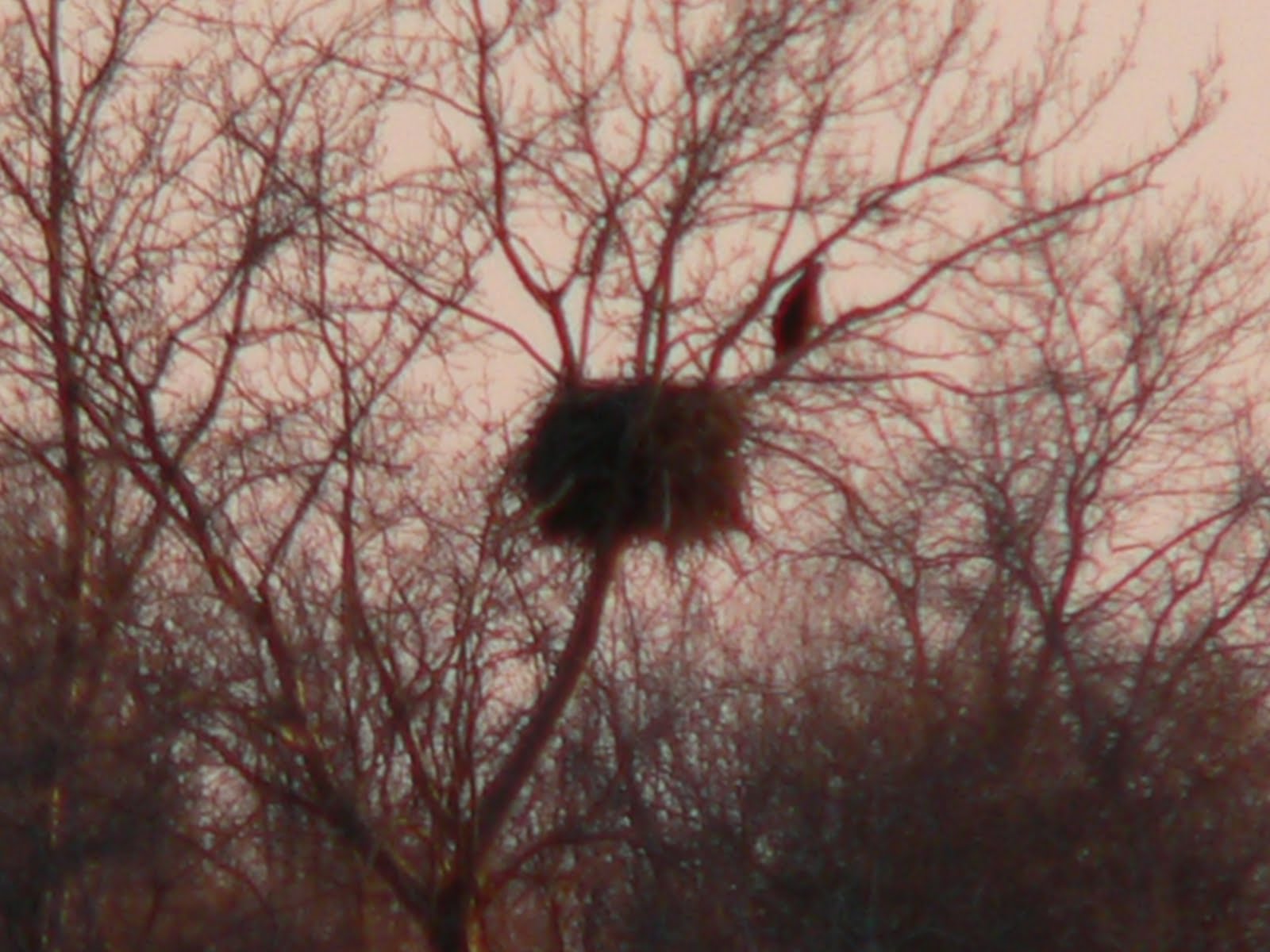
Very, very bad photo of a Bald Eagle (Ed swore he could see the white head and tail in the binoculars) possibly at its nest.


And another bad photo of displaying Common Goldeneyes - there were lots of 'em!


Other birds seen but not photographed: 

Trip Report - Southwest

.

Back to normal?  Maybe!  My scanning project was waylaid by a s-l-o-o-o-o-w computer, that problem is fixed, but now I've got new ones!  Can't use my faithful "Riptide" image program, so the pics in this post are uncropped and not resized. 

But we finally got to take a trip!  Had to pack all of our birding into one day, but we managed!  Our first tour was through the Alexander-Griswold marsh, where we picked up all of the expected ducks but two (dipped on Green-Winged Teal and American Wigeon). 

One of the first birds we spotted was a far off Swainson's Hawk! 


Western Meadowlarks are most conspicuous this time of year, singing for territoriy is serious business!  This fellow looks like he's crossing his legs.


A bit more classic pose.


Lots of ducks to be found, but not many good photos to be had!  Here are a few, starting with a Canvasback


A Northern Pintail


Northern Shoveler male (left) with Lesser Scaup Male (center) and female (right). 


Sorry this is a bad picture, but it includes a Ring-Necked Duck (second from right), another Canvasback, and a pair of Redheads.  We saw lots of Redheads and quite a few Gadwalls, but most were too far away for pictures. 


We also saw quite a few Blue-Winged Teals, but they were likewise skittish. 


Lots of American Coots around, these three are displaying. 


Tons of Red-Winged Blackbirds,


and Song Sparrows too!


We also saw a Wilson's Snipe, and quite a few Yellow-Headed Blackbirds.  Mammals were a little sparse, but we did spy a muskrat, a Richardson's Ground Squirrel, and this cutie (a Thirteen-Lined Ground Squirrel).


Our second destination was Whitewater Lake.  The wind had picked up by now, and the clouds were starting to roll in.  A big flock of Snow Geese was spied along the roadside.


Another Western Meadowlark. 


Flushed a pair of Gray Partridge from the roadside, here is a picture of one of them!


We also saw a few American Kestrels during the day.


And a single Horned Lark.


It started to rain soon after we got to Whitewater, and there wasn't too much to see. 


We thought about turning around, but decided to stick it out, and had lunch in the car. 


This trio of Common Grackles kept a close eye on things. 


Good thing we stayed!  In short order, there were ducks (Redheads and Scaup), gulls (Franklins or Bonapartes, couldn't see well enough to determine which), and a Double-Crested Cormorant, struggling to fly against the wind.  Then a pair of American Avocets out in the water.  Next to show up was a flock of American White Pelicans, then a flock of Tundra Swans!  Only bad pics, of course! 

Leaving Deloraine, we spotted a Eurasian Collared Dove.  These guys are new to the province, and it was a life bird for both of us. 


More Snow Geese and Tundra Swans seen along the highway.


Then a family group of Sandhill Cranes flushed across the road, and stuck around long enough for pictures. 


Our next sighting was another Swainsons Hawk,


And our last bird of the day was another Robin.


Other birds seen but not pictured:  Mallard, Canada Goose, Red-Tailed Hawk, American Crow, House Sparrow, Rock Pigeon, Killdeer, Ruddy Duck, Pied-Billed Grebe, Northern Harrier, Sharp-Tailed Grouse, Ring-Billed Gull, Brewer's Blackbird.
.

Tuesday, March 16, 2010

"Leucistic" Puffin - very cool

Very cool "leucistic" Atlantic Puffin, photographs here, tip given on the 10000 birds blog.

Time to revisit a rant...  Leucistic is a useless term.  The article states this bird is diluted. It's not, look at the dark spots.  It's got large white areas.  Another tipoff is the small dark areas on the rest of the body - a dilute will either be diluted overall, or will have one color diluted. 


The difference is clear to see, and the photo doesn't fit the description - looks more like the pigment is absent in most places, not that it's diluted.

Read my full-on rant here.
.
.

Friday, January 8, 2010

Junco with an eyering

I saw this bird in May of 2004, but sat on the pictures since because they are AWFUL!  I never quite figured out how to take window photographs with that camera - I have a few decent pics taken with it, but that's out of a TON of b-l-u-r-r-y ones. 


And here's some that aren't blurry!  First, another photograph from Hecla, also taken in May of 2005.  This is just such an insanely beautiful area!  I don't know if the strip on this birch was removed by a person - but a LOT of the trees in Hecla are stripped like this... 


And a bonus sunset.  This was taken June of 2005, I *think* in the neighborhood of Fort Whyte Alive, but I'm not positive. 


Monday, January 4, 2010

It's not a new year thing

I love new projects!  No particular attachment to a new year, I start projects year round.  Some I finish, some I don't.  My newest one is one I've been putting off for over four years now - scan all my photos taken with film cameras.  I can't even guess how many I've got, but have made a conservative estimate of about ten thousand.  I can scan, crop and rename about 100 a day, so thinking I might be able to get this done by spring, if I stick to it!  That is a very large "if" though, so we'll see how it goes.

One thing I'm finding interesting is how the old photos have such a different "look" from the digital ones.  My camera at the time was a point-and-shoot, but a pretty fancy one for the day - I got it in 1995, and it had a zoom that went all the way to 135 mm!  It lasted me until May of 2005, when it abruptly quit working, while I was trying to photograph a Pileated Woodpecker in Pinawa.  Waaah!!  Finished that trip with a few disposable cameras, and our new camcorder.


This photo was taken in the area between Brandon and Douglas in October of 2004.  I think I read about it in the "Birding in Southwestern Manitoba" book.  We got there late, and only saw a few Juncos.  Lovely view though, and we also saw some deer in the surrounding fields.


I have no idea when, or where this photo was taken.  Sighh...  I may be able to figure it out, this photo was in one of the boxes of second-rate photos, with nothing written on the back.  It may have been a double, as well - remember how cheap it used to be to get double prints made?  I used to do that all of the time...  But I've got a lot of those index prints, where the photo store would give you a photo sized print, showing all of the images from the roll of film.  So maybe this one will surface on one of those.


Gotta love distinctive structures!  I don't know when this photo was taken, but that's the Oak Hammock Marsh Interpretive Center!  

For comparison, here is a shot taken of the same area, with a digital camera.


Thursday, December 24, 2009

Single sighting - Prairie Falcon

I hope you'll forgive me this one - this bird, as well as the Cooper's Hawk, were actually found in Saskatchewan.  We had some great birding on that trip, which has been my only birding trip out of Manitoba.  The Cooper's (?) Hawk and this Prairie Falcon were both found in the Moose Mountain area during an overcast day.


Some people have great stories about finding birds, I'm afraid this isn't one of them!  We were driving along the road, I saw something in a tree, and stopped for photos!  When processing the photos when we got home, I initially assumed this was a Merlin.  Left the images in a folder for Hawks with no ID.  Then I saw a Merlin, at home.  And looked at a few photos. Prairie Falcons aren't very common in Manitoba, so this was a lucky sighting!

Why is this a Prairie Falcon, and not a Merlin?  The mustache mark is much more pronounced than on a Merlin.  The streaking is much finer, especially along the belly, which, along with the underside of the tail, is much whiter - almost unmarked.  This bird was also larger than a Merlin, with different proportions (longer body and tail)

Why is this not a Peregrine Falcon?  The mustache mark is much *less* pronounced than on a Peregrine.  This bird is very much brown-and-white, and the breast is streaked, not barred.  The breast of a juvenile Peregrine may be streaked, but it is usually dark brown on tan, not brown on white.

Here are some excellent Peregrine Falcon photos

Here are some great Prairie Falcon photos

Wednesday, December 23, 2009

That bird is a partial albino!


(Photo from Wikipedia Commons)

Um, no it's not. 

The wild bird sphere utilizes some odd terminology.  A bird that is more white (or just lighter) than usual used to be called albino, or partially albino.  More recently, the term "leucistic" has sprung up.  None of these are particularly useful, or even correct.

Why the insistence on using such generic terminology?  Am I missing something?  Why has the knowledge of color genetics gained through other research on other animals (including birds) not gained regular usage amongst birders?   

I spent a lot of time researching color genetics in horses, and in Peach-Faced Lovebirds, with minor forays into the color genetics of dogs, cats, other parrots, and chickens.  I have gotten started on a degree in genetics (just some first and second year courses under my belt). 

Albinism is a particular condition, a complete absence of pigmentation.  No, you can't have a partially albino individual.  They either are albino, or they aren't.  Partially albino is a useless, antiquated term.  In addition, if the bird is completely white, with dark legs and eyes, it is NOT an albino.

Within domestic bird populations (and occasionally wild birds), the first color mutations to occur are usually reduced pigment (dilution genes) and random de-pigmentation (spotting genes).

Small genetic mutations allow for different colors.  These mutations do occur in wild populations (Budgerigars, in Australia, for example - blue birds are occasionally seen in the wild) but these individuals do not usually live long enough to pass on their genetics.

The actual mutations of the genes involved do not occur more often in captivity than in the wild (as far as I know however, this hasn't been studied).  The difference is that they are usually disadvantageous in wild individuals (again, leading to a lessened chance for survival), but are almost always selected FOR in captivity.  Why do these small mutations occur then, if they don't translate to an advantage in wild animals?  That's that little "evolution" thing, you know, small changes in genetic code, some of 'em work, some of 'em don't. 

Most "off-color" or "aberrant" wild birds are not diluted - they have white patches in their plumage, which is otherwise normally colored.  Sometimes, this can be caused by injury - say a small bird is hit by a hawk but escapes.  It may acquire scar tissue, leading to some white-colored feathers.  However, most of these aberrant wild birds have much more white coloring than we would expect from an injury, such as an all-white head, or the Pigeon at the top of this post.  These individuals have a spotting gene.  Just like pinto horses, and Border Collies.  :)

I would very much like to see a better term applied to these birds, "leucistic" being much too general.  Click here for a  very brief overview of the word.  The most important point is that it is a VERY general description of a phenotype, indicating *nothing* of the genotype.  If the phenotype is visible enough to make enough of a distinction to label the bird as "leucistic", it's likely visible enough to say whether the individual is diluted, or spotted. 

Here's an example.  Pictured below are, left to right, a bay, a buckskin, and a bay pinto.


The buckskin is a bay horse with a dilution gene.  The pinto is a bay horse with a spotting gene.  But both could, technically, be considered "leucistic bays", even though the two phenotypes are so totally different, and caused by completely unrelated genes.  How silly it would be to lump them together.

So why do we lump it all together with birds?  Even at a distance, a spotted Pigeon is clearly distinct from a diluted (think "Fawn-colored") Pigeon.  Aren't we as birders scientifically sophisticated enough to make this basic distinction?

 If you made it all the way to the end, I thank you for your time, and apologize for my long-windedness!

Tuesday, December 22, 2009

Cooper's Hawk

Thinking that "pretty sure" isn't a good statement for what would be a new bird on the life list.  So here's the photo (click to enlarge), and my reasoning. 


Points for Sharp Shinned:  head looks small, possible white stripe above eye, body is wider towards the top (not tubular).

Points for Cooper's:  widest part of body is lower down (bird appears more barrel-shaped than narrow-waisted, although angle is awkward), tail appears more rounded than straight, white band on tip of tail is apparent, perching on fence post in the open, size (bird was definitely larger than a blue jay), eye is closer to beak (doesn't appear to be in the middle of the head)

Can't judge the legs or breast streaking, and since it appears to be a juvenile, can't use the nape color either.

These are the pages I used:

Identifying Cooper's And Sharp-shinned Hawks
Sharp-shinned and Cooper's Hawks


Inspecting this photo has made me question a yard bird we had a couple of years ago, which I thought at the time was a Sharp-Shinned, however it was also quite large.  I have no photos though, and my memory is sketchy!  So that bird will remain a "don't know".


Monday, December 21, 2009

Numbers, numbers, numbers...

Still obsessing with the numbering of my life list...  Am currently studying sandpiper photos, trying to decipher my poor blurry photos, most taken four years ago.  Feeding style?  I figure I'm doing well to remember where I took the dang photo!!  But I wonder about the numbering.  Would they go onto my list according to the date that I took the picture, or the date that I finally figured out what they were?  Sigh...  I think I've got the hawks figured out, anyways...  Got a bonus - had a photo where I couldn't decide,  had it in a folder for "no ID" but am pretty sure it's a Cooper's Hawk - one I hadn't added to my life list, so yay!

Friday, December 11, 2009

So many sightings, so few species

I'm almost finished reading "To See Every Bird On Earth", a story about birding, and a birder who has seen over 7000 species.  I also re-read "Birding:  Tales Of A Tribe".  Interesting to compare the two, the former is written by a non-birder who has been on many birding trips, and the second by a very keen birder. 

I don't see myself wanting to see that many birds...  I like birds, and taking bird trips, but that's extreme.  Whoa. 

It did make me curious for one thing - I wanted to have a chronological life list.  I want to be able to say what my 100th bird was.  I had a life checklist, but wasn't sure where it was.  Found most of my bird books and entered all the info I could find into a database.  Ended up with 2605 records.  For a piddly life list of 183.  Figured it would be at least 200.  Sigh.  I could increase it without birding if I could get some of my bad blurry photos recognized - my pics aren't good enough to say which peeps I've seen, so I didn't count any.  But that won't make it 200. 

It ends up being especially bad considering that my yard list is 75! 

Oh well, more excuse to go birding!

Saturday, December 5, 2009

Implications of feeding birds

This is a topic that always interests me - what effect do we have on wild birds when we put out bird feeders?  I worry almost constantly that I'm only helping the invasive House Sparrows and European Starlings when I put out bird food.

There's an article on BBC News (found on Birdchick) detailing the evolutionary changes underway within the Blackcap.

There's an interesting lack of opinion as to whether this is a good thing or a bad thing... Must nosh on these thoughts...

Saturday, November 28, 2009

November Tanager - part 4

The Tanager was back again today (Friday)!  A very quick sighting, from the tall tree in the west-side neighbors yard, to the fence, then along the creeper vine for a minute or two.  No good photos, settle for one bad one?


Other birds:  Black Capped Chickadees (at least three), a White-Breasted Nuthatch, female Hairy and Downy Woodpeckers.  

Thursday, November 26, 2009

November Tanager - part 3

No picture, but our Tanager was around yesterday, and today as well.  The berries in the yard are getting near to gone, not sure what s/he is going to do next.  Put out oranges in case it helps.  Hope the call of the south gets through soon!  It was a good birdy day in general - had four (possibly five) chickadees in the yard at once, a pair of White-Breasted Nuthatches, and female Downy and Hairy Woodpeckers.  And a Raven, gronking his way over the houses.

Sunday, November 22, 2009

November Tanager, day two!

Our Tanager came back! "Our". How funny, to be so possessive over a teeny wild animal! I'll blame E. - he's the one who saw it first. "Your bird's back!"

He went to the grapes first, then the Chokeberry. Spent a fair bit of time on top of the fence (scoping the area?) then climbed down for some Virginia Creeper berries. Then checked out the pond, sat in the elder for another minute, then took off to the top of the big tree at the back of the neighbors house.


.